Professional China Source OEM Service Supplier

M12 Connector slection guide
A-coded: sensors, actuators, DC power (5–12 pins) B-coded: Profibus, Fieldbus (9 pins) D-coded: 100 Mbps Ethernet (4 pins) X-coded: Gigabit Ethernet (8 pins) S/T/L-coded: AC/DC power (S=up to 16A, T=12A, L=DC power)
Jacky Duan
1/31/20261 min read
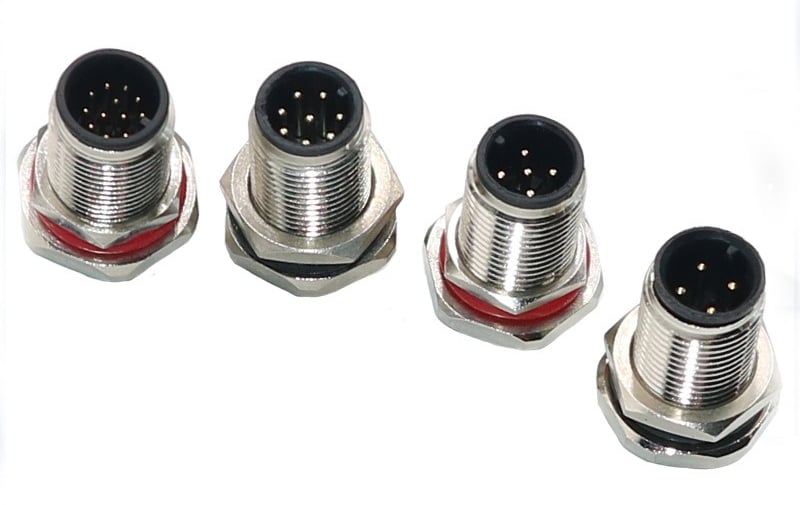
M12 connectors dominate factory automation and IIoT applications due to their compact size, robust sealing (IP67/IP69K), and coding options. As a supplier serving sensor, actuator, and Ethernet users, we offer the following selection advice to ensure reliable fieldbus and power connections.
1. Coding Selection – Critical First Step
A-coded: sensors, actuators, DC power (5–12 pins)
B-coded: Profibus, Fieldbus (9 pins)
D-coded: 100 Mbps Ethernet (4 pins)
X-coded: Gigabit Ethernet (8 pins)
S/T/L-coded: AC/DC power (S=up to 16A, T=12A, L=DC power)
Wrong coding leads to physical incompatibility. Always check device mating interface.
2. Pin Count and Contact Arrangement
Common: 3, 4, 5, 8, 12 pins. For hybrid data+power, use 8-pin A-coded or S/T-coded. Ensure contact current rating matches load (e.g., 4A for signal, up to 16A for power).
3. IP Rating and Environmental Durability
Standard M12 offers IP67 (temporary immersion). For high-pressure washdown (food/pharma), choose IP69K. Also check temperature range – industrial grade: -25°C to +85°C; extended: -40°C to +105°C.
4. Shielding and EMI Protection
For analog signals or Ethernet (D/X-coded), shielded versions (male housing with metal threads) are mandatory. Unshielded A-coded for basic DC sensors is acceptable.
5. Termination Options
Screw terminal: field installable, flexible
Crimp: high vibration resistance, needs tool
Spring-cage: faster, consistent force
PCB mount: for device integration
Overmolded cables: best for ingress protection and strain relief
6. Material Selection
Housing: brass nickel-plated (standard), stainless steel (corrosive), or PBT plastic (cost-saving). Coupling nut: metal for durability, plastic for lightweight. Contact plating: gold recommended for signal, tin for low-cycle power.
7. Common Mistakes from Supplier’s Log
Using A-coded for Ethernet – will not mate with D-coded device.
Ignoring torque (hand-tighten only 0.6–1.2 Nm; over-tightening damages threads).
Forgetting dust caps on unmated connectors in washdown areas.
8. Supplier Qualification
Demand UL, CE, and RoHS compliance. Request salt spray test reports (≥48h for nickel-plated brass). For custom cable lengths, work with suppliers offering fully overmolded assemblies to eliminate field wiring errors.
We stock all codings and can deliver pre-tested assemblies. Contact our engineering team for pinout verification.
Aureate Technology
Explore our sleek website template for your industrial products
Contact
Inquiry
aureatetech@126.com
008613363961067
© 2024. All rights reserved.