Professional China Source OEM Service Supplier
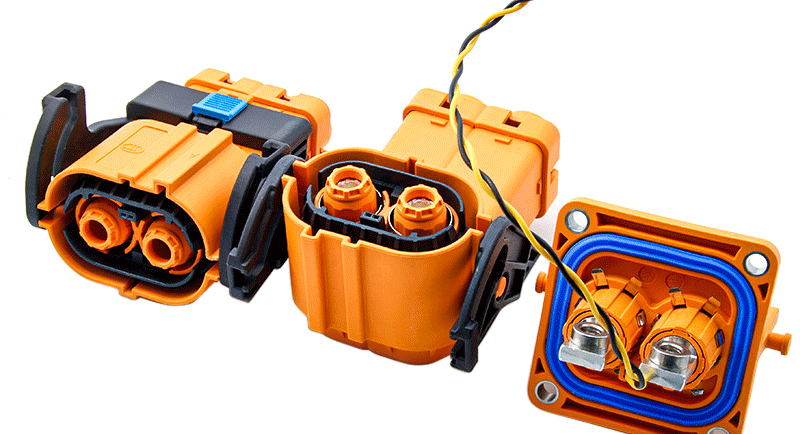
New Energy Vehicle (EV) High-Voltage Connector Series
Every HV connector series we offer includes HVIL contacts. HVIL monitors mating status and signals the battery management system (BMS) to cut power before separation. Always check: number of HVIL circuits (usually 2), and contact resistance (<20mΩ). Avoid connectors without HVIL in traction systems.
3/10/20262 min read
1. Voltage and Current Classes – Define Your Series
≤600V / ≤250A: typical for 400V architecture (e.g., 2-pin or 3-pin connectors for battery-to-inverter).
800V–1000V / ≤400A: emerging 800V platforms require enhanced creepage/clearance and partial discharge control.
Charging connectors: CCS1/CCS2, GB/T, or CHAdeMO – these are standardized but we supply matching inlets and harness assemblies.
Select a series that provides a safety margin of at least 20% above peak operating voltage/current.
2. HVIL (High-Voltage Interlock) – Mandatory Feature
Every HV connector series we offer includes HVIL contacts. HVIL monitors mating status and signals the battery management system (BMS) to cut power before separation. Always check: number of HVIL circuits (usually 2), and contact resistance (<20mΩ). Avoid connectors without HVIL in traction systems.
3. Shielding and EMC
Full 360° EMI shielding is required for HV cables to prevent interference with vehicle CAN/LIN networks. Our series offer:
Shielding termination: cable shield clamped to connector housing.
Transfer impedance <10mΩ/m at 1MHz.
For shielded series, ensure the mating interface also provides shielding continuity.
4. IP Rating and Environmental
Minimum IP67 for underhood and underbody. For battery pack pass-through, specify IP6K9K (high-pressure washdown). Temperature range: -40°C to +125°C (underhood). Also request thermal shock tests and salt spray (≥480h ISO 9227).
5. Terminal and Contact System
We group connectors by terminal type:
Rack-and-panel series: large blade terminals (up to 120mm² cable) – for battery module connections.
Crimp-contact series: machined or stamped contacts with secondary locking.
Busbar series: for rigid copper busbar connections (low inductance).
Contact plating: silver (excellent conductivity, tarnishes) or gold (more stable for low-level HVIL signals). For high-cycle applications (e.g., charging port), use gold-plated with ≥1.27µm thickness.
6. Coding and Mechanical Keying
To prevent mis-mating in crowded battery packs, our HV series offer 2–6 mechanical keying options. Color coding (orange for HV, black for LV) also required per EV standards. Always specify keying code in your BOM.
7. Cable-to-Device vs. Cable-to-Cable
Cable-to-device (right-angle or straight PCB mount): for inverters and DCDC converters.
Cable-to-cable (inline): for battery pack to motor, or charging harness extensions.
Our series include both; note that inline connectors require additional sealing caps and strain relief.
8. Supplier Qualification for Automotive
We maintain IATF 16949 certification. We provide:
USCAR-2 or LV214 test reports (mechanical/electrical durability).
Vibration profile (random vibration per ISO 16750-3).
Terminal pull-out force and temperature rise data.
Avoid non-automotive grade connectors – they lack vibration robustness and HVIL reliability.
Contact our engineering team for sample kits of our 400V/800V series. We also offer custom keying and color coding.
Aureate Technology
Explore our sleek website template for your industrial products
Contact
Inquiry
aureatetech@126.com
008613363961067
© 2024. All rights reserved.